Infrastructure-driven businesses are operating in an environment defined by variability.
According to industry reports, three out of five SaaS companies now rely on usage-based or hybrid pricing models, which have significantly contributed to their evolution and significance today. At the same time, billing errors are estimated to cost subscription and usage-based businesses 1 to 5 percent of annual recurring revenue due to leakage.
Every fluctuation, upgrade, and spike directly impacts revenue recognition. And when billing systems are not designed to process variability automatically, the burden falls on the workforce. What begins as a manageable workaround becomes a structural risk as scale increases.
This is why the shift toward AI-automated billing platforms is accelerating—an operational redesign built to support modern, usage-driven revenue models.
From Reactive Billing to System-Level Automation
Traditional billing platforms were designed around predictable subscription models. They assume static pricing, stable services, and limited mid-term adjustments. Calculations are also performed at invoice time using pre-configured rates.
In contrast, AI-automated billing platforms transform billing into a structured intelligence layer that applies predefined rules consistently across customers and services.
In this system, usage events are ingested in real time through APIs. Aggregation methods determine how metrics are calculated, whether summed, averaged, or counted. Tiered pricing logic applies automatically based on defined thresholds, and contract terms govern renewals, penalties, and scheduled price adjustments.
For infrastructure-heavy providers, consolidating billing, device management, ticketing, and service workflows into a unified AI-automated platform improves accuracy and governance. When operational data and financial logic are unified, discrepancies are evitable and billing becomes auditable.
Why Usage-Based Revenue Requires Technical Precision
Usage-based billing introduces specific technical requirements:
- Event-driven data ingestion
- Accurate aggregation methods
- Tiered and threshold-based pricing
- Multi-service and multi-tenant tracking
- Real-time synchronization between monitoring systems and billing logic
Even small inaccuracies compound over time. If a bandwidth aggregation rule miscalculates by 2 percent across hundreds of customers, the revenue impact is significant. For every inaccurate and overlooked pricing change, dispute increases and margin erodes significantly.
AI-automated platforms reduce these risks by embedding calculation logic directly into system workflows. In these models:
1. A meter defines the usage type being tracked.
2. Usage events are transmitted programmatically via API.
3. Aggregation logic calculates totals during the billing period.
4. Pricing tiers are applied automatically based on configuration.
5. Charges are generated without manual recalculation.
This process reduces human intervention while maintaining transparency. Technical teams can validate usage accuracy, and finance teams can rely on system-generated outputs rather than manual spreadsheets
Contract Lifecycle Management as a Control Layer
Billing complexity extends beyond usage metrics. Contracts introduce structured commercial obligations that must be enforced consistently. Infrastructure contracts often include:
- Fixed or auto-renewing terms
- Early termination penalties
- Scheduled price increases
- Quantity adjustments tied to milestones
- Bundled services under a single agreement
Managing these variables individually across services does not scale efficiently. Contract Lifecycle Management (CLM) introduces a centralized control layer, where services can be grouped under a contract entity, renewal is predefined and automatic, and price and quantity updates can be relatively scheduled.
For example, a 10 percent price increase six months after activation can be configured once and applied automatically, even if provisioning timelines shift. This reduces missed renewals, incorrect pricing updates, and administrative inconsistencies—all while avoiding manual workload.
Unified Operations for Cross-Department Friction
Many infrastructure organizations rely on separate systems for billing, ticketing, device monitoring, and CRM operations. When these systems operate independently, data synchronization delays and reconciliation challenges arise. Visibility gaps and tool fragmentation between departments create operational friction.
Unified AI-automated billing platforms consolidate these workflows:
- Tickets can be associated directly with services and contracts.
- Usage metrics tie to specific billable entities.
- Service changes automatically reflect in the billing logic.
- Reporting aligns infrastructure performance with financial output.
By working from a shared operational system, teams improve cross-functional alignment. Organizations achieve reduced billing disputes, faster month-end close, fewer manual corrections, improved revenue forecasting, and greater audit-readiness.
The Strategic Advantage: Ubersmith
If billing accuracy depends on manual work, both the operations and revenue are unstable. AI-automated billing platforms are a necessity for organizations focused on sustainable growth. As infrastructure becomes more dynamic, revenue systems must reflect that complexity.
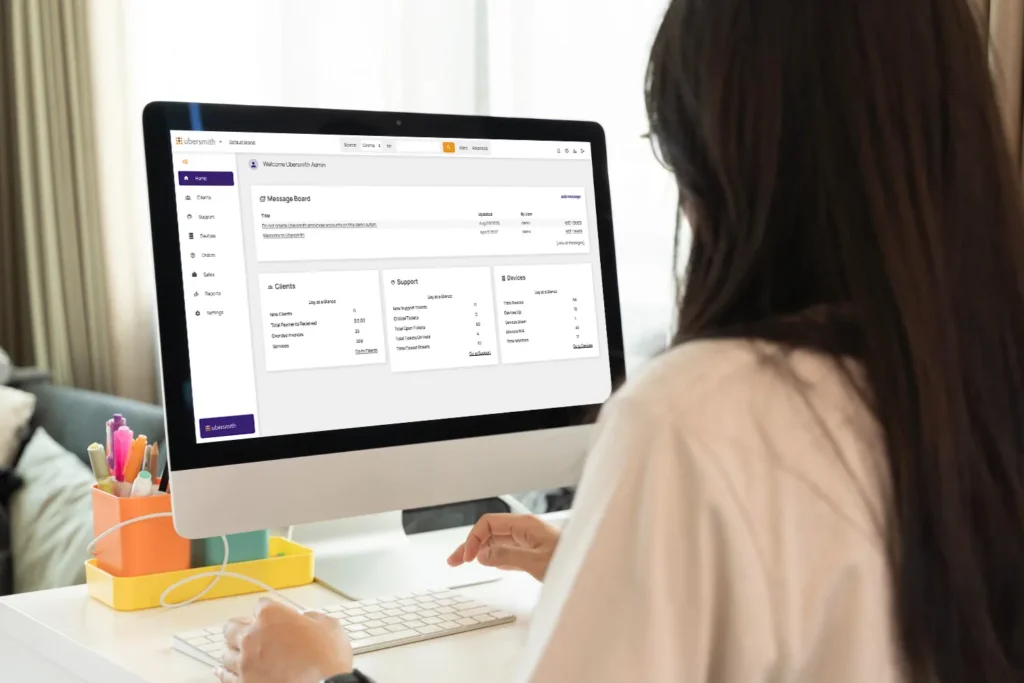
AI-automated billing platforms such as Ubersmith represent a practical evolution, aligning workflows into a single, cohesive operational framework. Rather than treating billing as a standalone module, the platform connects usage metering, infrastructure monitoring, ticketing, and contract lifecycle management into a unified system.
Ubersmith’s operational intelligence helps teams achieve faster invoicing, accurate billing, and clearer operations. Billing becomes the natural output of synchronized infrastructure, contract, and service data rather than a manual accounting effort.
If your billing process requires ongoing manual correction or cross-team reconciliation, it may be time to evaluate whether your current system can support your next phase of growth.
Explore how a unified, AI-automated billing platform can reduce operational strain and improve revenue accuracy.
Frequently Asked Questions (FAQs)
1. What is an AI-automated billing platform?
It is a unified system that integrates usage metering, infrastructure monitoring, ticketing, and contract management to automatically apply billing rules based on real-time operational data.
2. Why is usage-based billing more complex than flat-rate billing?
Usage-based models require accurate event tracking, aggregation logic, tiered pricing enforcement, and synchronization with infrastructure data. Manual processes increase the risk of inaccuracies.
3. How does contract lifecycle management improve billing governance?
CLM centralizes contract terms, automates renewals and scheduled updates, and ensures pricing logic is applied consistently across services and billing cycles.
4. What operational risks arise from fragmented billing systems?
Disconnected tools increase reconciliation workload, create visibility gaps, and raise the likelihood of billing disputes or revenue leakage.
5. When should an organization transition to AI-automated billing?
Transition becomes urgent when manual corrections dominate billing cycles, usage models become more dynamic, or legacy systems fail to integrate effectively with operational infrastructure.

PHP CVE-2026-109618 and CVE-2026-109619 Patch Utility
The PHP project’s fixed releases close the vulnerabilities described in our prior customer notices. patch_php_cve.sh and patch_appliance_php_cve.sh updates your installation to the patched container images.

Version 5.3.0
This update enhances tracking for client relationships, adds drag-and-drop image support in tickets, and includes event triggers for DNS management, along with fixes for search, invoice, and payment processing issues.

8 Things to Look for in a Support Ticketing and Billing Platform
For cloud and dedicated server providers, the misalignment between support ticketing and billing platform extends to revenue and retention risk.
Version 5.2.3
This update enhances tracking for client relationships, adds drag-and-drop image support in tickets, and includes event triggers for DNS management, along with fixes for search, invoice, and payment processing issues.

How to Choose Subscription Billing Software
The market for subscription billing software has grown substantially in volume, and the differences between platforms are not always noticeable from a product demonstration.
What Is Contract Lifecycle Management (CLM) Software
Managing a customer relationship in an infrastructure or services business extends beyond handling more than account communications and renewals.