
California is not a typical hosting market. Northern California’s data center market was valued at 1.91 thousand MW in 2025 and is projected to reach 2.01 thousand MW in 2026 and 2.62 thousand MW by 2031. This is primarily driven by the densest concentration of hyperscale cloud and AI infrastructure in the world. Southern California logged a record 22.7 MW of net absorption in 2024 alone, with all existing under-construction capacity fully preleased before delivery.
Operators in this market are not exploring whether automation matters. They already run multi-tenant colocation environments, bare-metal deployments, and usage-driven service contracts at a scale where manual processes simply do not suffice. The question at this stage is which platform is actually built for that environment, and which ones only look the part on a demo.
This article is written for operators who are shortlisting. It covers the operational context specific to California hosting providers and the five platform criteria that genuinely separate capable automation software from tools that overpromise and underdeliver in infrastructure-heavy environments.
What California Hosting Operators Are Actually Running
A California-based hosting or colocation operator typically manages several billing variables simultaneously, including power consumption metered per rack or cabinet, bandwidth usage tracked per port or per customer, multi-tenant contracts with different renewal dates and pricing structures, and device fleets that require real-time monitoring directly tied to service delivery.
Regional growth also adds another layer of pressure. Tenant onboarding has accelerated, AI workload customers are demanding higher-density configurations, and the competitive market now treats pricing accuracy and uptime transparency as baseline expectations.
A platform needs to handle all of that without requiring a team of people to reconcile usage data, chase contract renewals, or manually cross-reference billing records against infrastructure logs. Those are the operational realities a capable automation platform should be designed around.
What to Look for in AI Hosting Automation Software
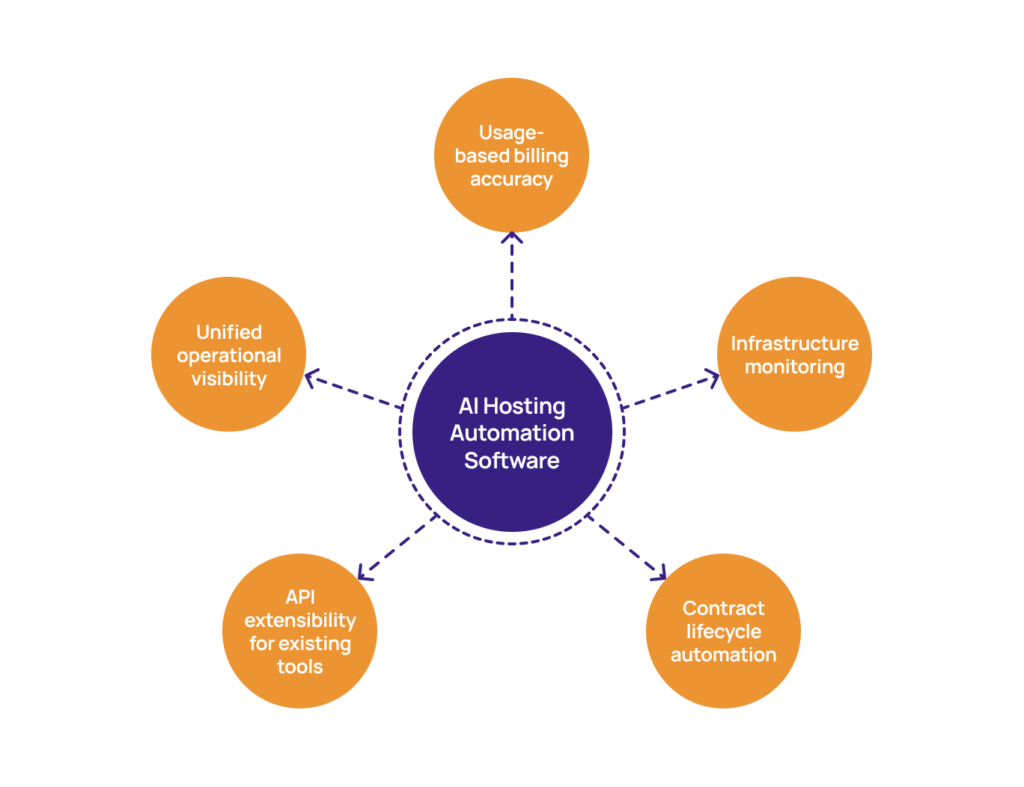
Most platforms advertise automation. Far fewer are built for the operational architecture of a hosting or colocation business in California. Here are the five criteria that matter most at this stage of evaluation.
1. Usage-based billing accuracy across power, bandwidth, and devices.
Generic billing platforms handle recurring charges cleanly. They break when the billable variables are physical, like kilowatt-hours consumed per tenant, 95th-percentile bandwidth calculations, and per-device service fees. A platform built for hosting environments automates those calculations end-to-end, pulling from real usage data rather than relying on manual input. If a platform requires a spreadsheet at any point in that process, it is not a production-ready solution for this market.
2. Infrastructure monitoring tied directly to billing data.
Billing accuracy and infrastructure visibility need to be connected. When device data (network health, power draw, and uptime metrics) feeds directly into billing logic, invoices reflect actual consumption and disputes become easier to resolve with an audit trail. A platform that keeps monitoring and billing in separate systems forces teams to manually reconcile data that should never be separated in the first place.
3. Contract lifecycle automation.
In a multi-tenant environment with hundreds of contracts at different renewal stages, manual tracking leads to revenue leakage. Price escalations get missed. Renewals roll over without the agreed adjustment. And cancellations are processed late. A capable platform automates the full contract lifecycle, from triggering renewals and applying pricing changes on schedule to enforcing terms consistently across the customer base — all without requiring anyone to manage it in a spreadsheet.
4. API extensibility for existing provisioning and CRM tools.
No hosting operator starts from scratch. Every team has provisioning workflows, CRM integrations, and support tooling already in place. An automation platform needs to work with that infrastructure, not completely replace it. Open API architecture and a plugin framework are what allow a platform to integrate cleanly with existing workflows, without creating another silo alongside the ones already there.
5. Unified operational visibility.
A CTO or VP of Operations needs to see billing, infrastructure, support, and contracts from a single operational dashboard. When those data sources are fragmented across different tools, decision-making slows and reporting becomes a manual exercise. In a high-density, high-contract-volume environment, unified visibility is what separates proactive operations management from constant troubleshooting.
Ubersmith is built around all five of these criteria. The platform was designed specifically for infrastructure-based businesses that sell and manage power, bandwidth, and hosting capacity. Every module, from usage-based billing to contract lifecycle automation to infrastructure monitoring, was built for this operational context rather than adapted from a different use case.
Why Purpose-Built Matters More Than Feature Volume
A common mistake at this stage of evaluation is comparing platforms by feature count. A longer list of capabilities makes a product look stronger. But in practice, it often signals a platform built broadly, one that handles many use cases adequately instead of handling one use case exceptionally well.
Platforms like Zuora and Chargebee are well-engineered for SaaS and subscription businesses. They handle recurring charges, seat-based pricing, and digital service tiers with precision. What they were not designed for is the billing logic of a hosting environment: variable power consumption, bandwidth metering, device-level service tracking, and multi-tenant colocation contracts with custom renewal terms. Using a SaaS billing platform for that operational model creates gaps that teams end up filling manually, which is exactly the overhead that automation is supposed to eliminate.
A purpose-built platform, like Ubersmith, is important because edge cases in California-based hosting operations are central to the business. A platform with 22 years of deployment history serving data centers, MSPs, ISPs, and hosting providers has already encountered and solved the operational problems that a generic billing tool will surface for the first time in a live production environment.
See How Ubersmith Fits Your Hosting Operation
If the criteria above reflect what your team is evaluating, it is worth seeing how Ubersmith performs against your specific environment. Request a walkthrough tailored to your hosting operation here.
Frequently Asked Questions (FAQs)
1. What makes hosting automation software different from standard billing platforms?
Standard billing platforms handle recurring charges and flat-rate services well. They are not built for variable, usage-driven billing tied to physical infrastructure, including power consumption, bandwidth metering, and device-level tracking.
2. How important is infrastructure monitoring integration when evaluating automation software?
Critical. A platform that connects monitoring and billing eliminates the reconciliation step entirely and avoids delays, error risk, and staff overhead.
3. Can AI hosting automation software integrate with existing provisioning and CRM tools?
A well-architected platform should. Open API access and a plugin framework allow the software to connect with existing provisioning and CRM tools without forcing teams to rebuild workflows. Verify that the API is documented and actively maintained before committing.
4. What operational problems does contract lifecycle automation solve for hosting providers?
Missed price increases, late renewals, and inconsistent contract enforcement — all of which translate to revenue leakage. Automation applies pricing adjustments and renewal terms on schedule across every contract, without manual tracking.
5. Is Ubersmith suitable for smaller California hosting providers or only enterprise-scale operators?
Ubersmith is built for infrastructure-based service providers across a range of operational scales. Its modular architecture allows teams to start with what they need and expand as complexity grows.