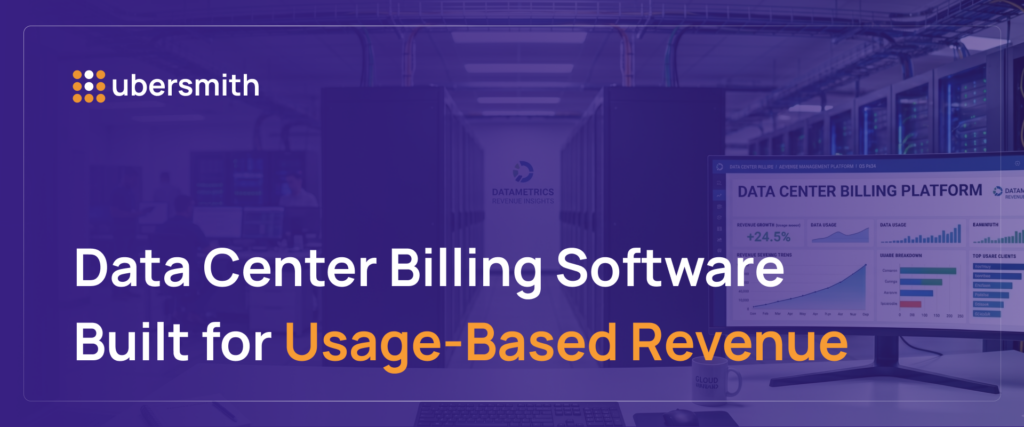
Most data center billing software was designed for businesses that sell software subscriptions at fixed monthly rates.
Data centers, colocation providers, and hosting operators do not work that way. Their revenue is consumption-driven — variable by nature and dependent on what each customer consumes in power, bandwidth, and device usage across any given billing cycle.
Ubersmith was built specifically for that model. Every feature, every automation layer, and every workflow in the platform reflects the operational reality of infrastructure-based businesses.
Built for the Way Data Centers Actually Bill
Ubersmith’s architecture starts from a fundamentally different assumption than generic billing platforms. Tools like Zuora or Chargebee serve subscription and digital usage models well. Their core design is oriented toward SaaS, media, and digital services businesses billing on seats, API calls, and compute hours. They were not built for the operational complexity of infrastructure providers managing physical power draw, cabinet-level bandwidth, and device metering across variable customer environments.
Ubersmith, an AI-automated billing and operations software, was purpose-built for businesses that sell and manage power, bandwidth, physical devices, and hosting capacity. The platform handles the billing complexity that infrastructure providers face daily — tiered usage pricing, mid-cycle consumption changes, device-level tracking, and multi-service invoicing — without requiring workarounds or third-party patches. For a data center evaluating billing software, that distinction is not a foundational difference.
How Ubersmith Handles Usage-Based Billing
Ubersmith automates billing for power draw, bandwidth consumption, and device-level usage in real time. Usage data flows directly from infrastructure monitoring into invoice generation, without manual exports, spreadsheet reconciliation, and lag between what a customer consumes and what appears on their bill.
The platform supports metered billing through a structured event-based system. Usage events are recorded against each service, aggregated according to the configured pricing tiers, and applied automatically to the billing cycle. Whether a customer is drawing variable kilowatts across a colocation cabinet or consuming bandwidth at fluctuating rates throughout the month, Ubersmith captures it accurately and invoices accordingly.
This direct connection between consumption data and billing output is what eliminates underbilling. When usage data is stored in a separate monitoring tool that does not integrate with the billing system, discrepancies accumulate silently. Ubersmith addresses that gap directly, connecting infrastructure data and billing output within a single system.
Contract Automation That Protects Revenue
Usage-level billing accuracy alone does not fully protect revenue. Data centers also lose revenue due to missed contract milestones, including scheduled price increases that were never applied, renewals that rolled over at outdated rates, and escalation clauses that required manual tracking to enforce. Studies from World Commerce & Contracting consistently show that companies lose an average of 8.2% to 9.2% of a contract’s annual value due to leakage. Moreover, a 2022 report by Boston Consulting Group (BCG) found that one organization missed 3.5% of potential revenue from unexecuted contract price adjustments alone — a figure that translates to more than $1 million in lost income on a $30 million revenue base.
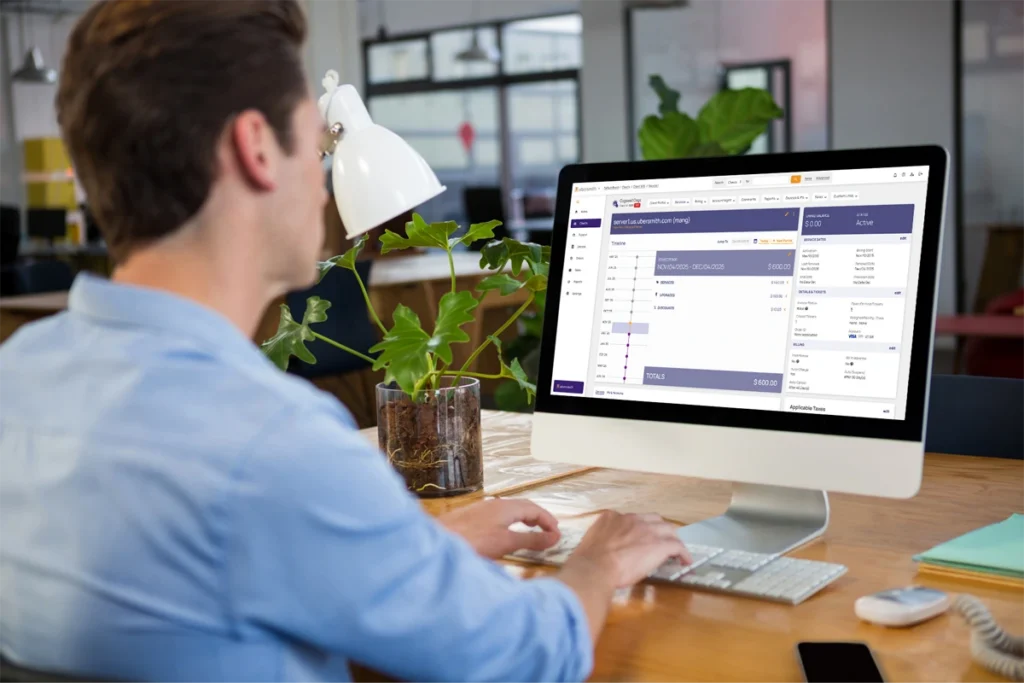
Ubersmith automates the full contract lifecycle to enforce those milestones without manual oversight. Scheduled price increases, renewal enforcement, and pricing tier updates are applied consistently and automatically, without requiring a finance manager to monitor a spreadsheet or set calendar reminders.
Through the Contract Lifecycle Management add-on, contracts group related services so that pricing updates, quantity changes, and renewal terms are managed at the contract level rather than at each service individually. Scheduled price increases are configured as relative events and applied automatically at invoice time across every service within that contract. If a service start date shifts, the schedule adjusts accordingly, so the timing always reflects the actual contract terms. Renewal behavior is also set at the contract level, with auto-renewal options and renewal-specific update schedules that carry the correct pricing forward without requiring anyone to intervene. Scheduled templates can be saved and applied across multiple contracts, which is particularly valuable for data centers managing large customer volumes where recreating the same pricing logic repeatedly is both time-consuming and error-prone.
For a CFO or VP of Operations evaluating data center billing software, contract automation serves as a revenue recovery mechanism and one that pays for itself quickly.
One Platform Across Billing, Infrastructure, and Support
Ubersmith consolidates billing, infrastructure monitoring, support ticketing, and contract management into a single integrated system. Teams working across those functions operate from the same data, in the same platform, without duplicating work across disconnected tools.
The practical impact of that consolidation is significant:
• Billing accuracy improves because usage data comes directly from infrastructure monitoring, not from a manual export or an integration that can break.
• Support resolution speeds up because tickets are linked directly to the customer’s services and devices, giving teams immediate context.
• Finance and operations stay aligned because contracts, invoices, and service records are visible in one place rather than scattered across separate systems.
Ubersmith’s open API and plugin architecture also allow it to integrate with existing tools — CRMs, ERPs, network monitoring platforms — so the consolidation does not require ripping out infrastructure that already works. It adds coherence to what is already in place, while replacing the systems that were creating friction.
For data centers managing a growing customer base, the operational coherence that Ubersmith provides is what makes scaling manageable. More customers and more services add complexity. A unified platform keeps that complexity from compounding into revenue leakage and manual overhead.
Why the Right Data Center Billing Software Is a Revenue Decision
Data centers running on usage-based revenue models cannot afford data center billing software built for a different kind of business. Every unbilled kilowatt, every missed contract increase, and every hour spent reconciling disconnected systems represents revenue that was earned but never collected. Ubersmith was built to close those gaps — not as a feature addition, but as the core purpose of the platform.
From real-time usage metering tied directly to invoicing, contract schedules that enforce pricing without human intervention, to a unified system that keeps billing, infrastructure, and support aligned, Ubersmith gives data centers the operational foundation to scale without leaking revenue.
Ready to see it in your environment? Request a walkthrough here.
Related Readings:
• AI-Automated Billing Platform for Data Centers in Texas
• AI-Driven Colocation Billing Software in Florida
Frequently Asked Questions (FAQs)
1. Can Ubersmith handle billing for both power and bandwidth within the same invoice?
Yes. Ubersmith supports multi-service billing within a single invoice, covering power draw, bandwidth consumption, and device-level usage. Each service is metered separately and aggregated automatically at invoicing.
2. How does Ubersmith prevent underbilling when usage fluctuates mid-cycle?
Ubersmith captures usage events in real time and applies them to the current billing period based on configured pricing tiers. Because usage data flows directly from infrastructure monitoring into the billing engine, mid-cycle changes in consumption are reflected accurately in the final invoice.
3. Does Ubersmith replace existing monitoring or ticketing tools, or does it integrate with them?
Both are possible. Ubersmith includes native infrastructure monitoring and support ticketing, but its open API and plugin architecture also support integrations with third-party CRMs, ERPs, and network monitoring platforms.
4. How does Ubersmith handle contract price increases automatically?
Price increases are configured as scheduled events within each contract and applied automatically at invoice time. Once set, they execute at the correct intervals without any manual follow-up.
5. What types of data center businesses is Ubersmith built for?
Ubersmith serves data centers, colocation providers, hosting operators, MSPs, and ISPs — specifically those running usage-based or hybrid revenue models.