Selecting billing and CRM software for a service provider operation is a procurement decision with direct consequences for revenue accuracy, operational efficiency, and the ability to scale without compounding manual overhead. The platforms most frequently appearing in shortlists were built around SaaS subscription models. While they perform reliably in that context, they were not designed for environments where billable output is variable, contracts carry escalation logic, and infrastructure data must feed directly into the invoicing process.
For data centers, MSPs, ISPs, and cloud providers actively evaluating platforms, the gap between general-purpose tooling and purpose-built solutions becomes visible at the requirements stage. The framework below is designed to help operations and technology leaders assess that fit before committing to a vendor.
Why Most Billing and CRM Software Fails Service Providers at Scale
The majority of billing platforms were designed around predictable, fixed-price subscription models. Many tools serve SaaS businesses well precisely because SaaS revenue is seat-based and uniform. A data center billing for metered power consumption, an ISP tracking bandwidth usage across hundreds of subscribers, or an MSP managing tiered service contracts across dozens of clients does not fit that model cleanly. When service providers force their operations onto platforms built for a different revenue model, the gaps show up as daily workflow problems.
Teams end up manually importing usage data before an invoice can be generated, tracking contract escalations in tools disconnected from the billing system, and maintaining separate client records across billing, support, and operations. According to MGI Research, companies lose between 1% and 5% of annual revenue to billing-related errors — a range driven almost entirely by billing gaps, missed usage, pricing inconsistencies, and contract misalignment. For service providers operating at scale, that gap is structural and it widens with every client added.
What to Evaluate Before You Choose a Platform
Shortlisting a billing and CRM platform without a structured evaluation framework often results in vendors demonstrating capabilities in isolation, edge cases surfacing post-signature, and migration costs exceeding projections. Before engaging any vendor, pressure-test your shortlist against these eight requirements:
1. Native usage-based billing logic
The platform must calculate charges directly from live consumption data (power, bandwidth, and metered services) without manual imports or middleware dependencies. A vendor that describes this capability as a configuration option or an add-on module is often unintentionally disclosing that the platform’s core architecture was not built for this environment.
2. Flexible billing and subscription logic
While usage-based billing is a baseline requirement, the platform must also support recurring subscriptions, hybrid service models, one-time charges, and mid-cycle modifications (upgrades, suspensions, and plan changes) without requiring manual intervention. Billing model rigidity compounds in direct proportion to service catalog growth.
3. Contract lifecycle automation
Renewals, price escalations, and cancellations must be executed automatically in accordance with contract terms. Any operation that relies on spreadsheets or calendar reminders to manage contract milestones introduces a revenue risk that grows with each client relationship added to the portfolio.
4. A unified client record
Billing, support, and operations must draw from a single account record. When a support ticket is opened, the assigned agent should have immediate access to service history, active contract terms, and current billing status without a system change or a cross-team request.
5. Real-time operational visibility
Finance and operations leadership require a live view of revenue, usage, device status, and contract performance from a single reporting layer. A platform that cannot surface this data in a unified dashboard forces leadership to make decisions from lagging, manually assembled information — an operational and strategic liability at scale.
6. Integration with provisioning and infrastructure monitoring.
In a physical infrastructure environment, billing accuracy depends on device and usage data that originates outside the billing system itself. The platform must maintain an automated, reliable data path from infrastructure to invoice. Manual sync processes at this stage are an audit and revenue assurance risk.
7. Scalable architecture with a clear ROI path.
A platform built on open APIs and a modular architecture can absorb operational growth, such as new service lines, additional sites, and expanded client tiers, without requiring a system rebuild. When evaluating this requirement, ask vendors for specific examples of how the platform has scaled for operations at your current stage and at the stage above it.
8. Implementation quality and ongoing support.
Platform migrations carry defined operational and financial risk. Evaluate the vendor’s onboarding methodology, data migration approach, and transition period protocols. Vendors with extended tenure in the service provider space have resolved edge cases that newer entrants have yet to encounter.
When a Unified Platform Makes More Sense Than Separate Tools
The stacked-tools approach is a standalone billing system integrated with a separate CRM and a separate ticketing platform. It is a legitimate architecture where each system was purpose-built for the service provider environment and the integrations between them are stable, well-documented, and maintained. That condition is rarely met in practice. Most service providers running separate tools carry a silent engineering overhead in the form of integration maintenance, and the failure points in that architecture concentrate around the operational moments of highest consequence, like month-end billing runs, contract renewals, and high-volume support periods.
Three indicators reliably signal that a unified platform will deliver better operational and financial outcomes than a stacked approach:
• Manual reconciliation between billing and client data has become a recurring monthly obligation.
• Billing disputes require cross-functional investigation because no single system holds a complete account record.
• Integration failures between existing tools have produced billing errors or service delivery gaps.
When all three conditions are present simultaneously, the total cost of maintaining the stacked architecture in engineering hours, revenue exposure, and leadership attention exceeds the cost and disruption of consolidating onto a single platform.
Ubersmith, an AI-automated platform, was purpose-built for exactly this consolidation requirement and is designed specifically for data centers, MSPs, ISPs, and cloud providers. Usage-based billing, contract lifecycle management, infrastructure monitoring, support ticketing, and client management operate within a single system. This eliminates the integration layer that most service providers in this space are currently sustaining through manual effort and custom-built connectors.
What to Ask During a Demo or Evaluation Call
The questions below are designed to move any vendor conversation past the demonstration environment and into the operational reality your team will inherit post-implementation. Bring them into every platform walkthrough, including any conversation with Ubersmith.
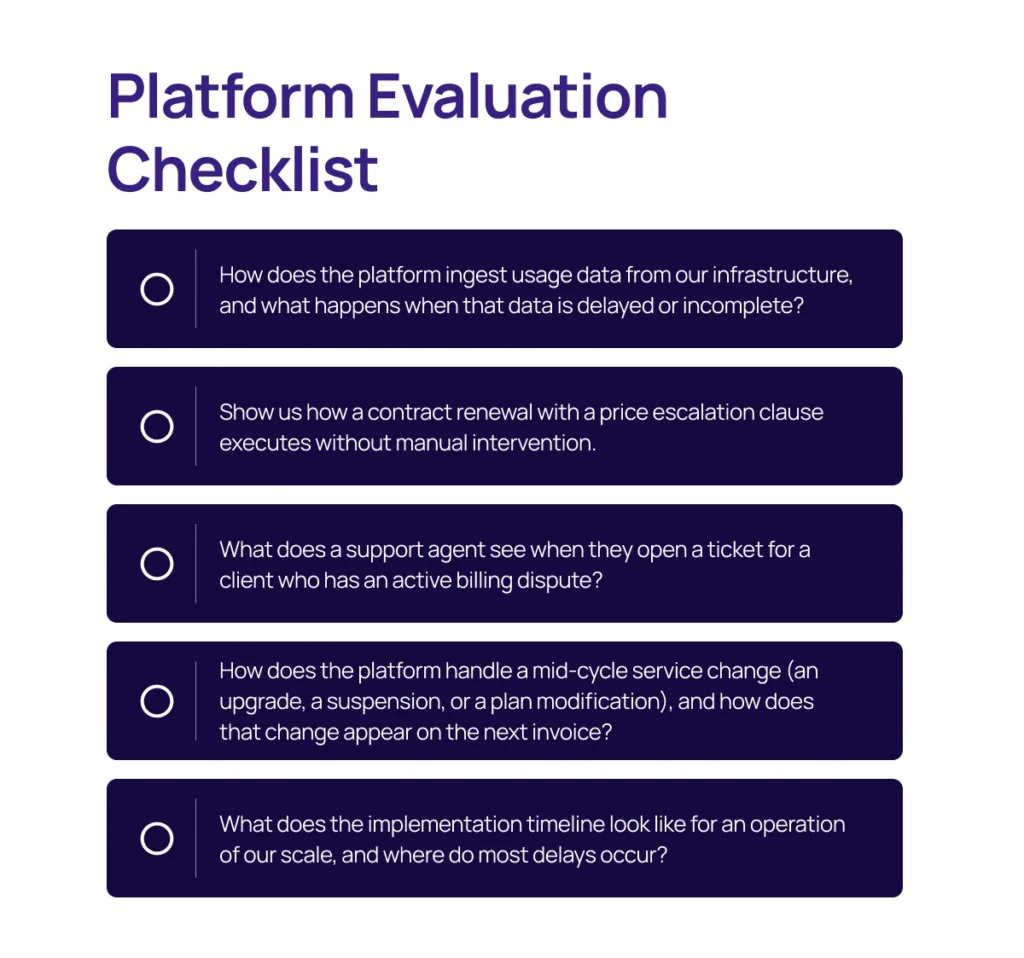
The answers to these questions will reveal more about real-world platform fit than any feature matrix or product roadmap presentation.
Making the Right Decision for Your Operation
Platform selection at this level is an operational and financial commitment that will shape how your billing, support, and infrastructure teams work for years. The right platform reduces the manual overhead, recovers revenue, and gives leadership the visibility needed to make decisions.
For service providers, the evaluation criteria outlined in this article reflect the requirements that generic platforms consistently fail to meet at scale. A platform that handles metered consumption natively, automates contract lifecycle events without manual triggers, and consolidates client data across every operational function is the baseline for running a service provider business at the growth stage.
If your evaluation has reached the point where you are ready to see how these requirements translate into a working system, Ubersmith offers a tailored walkthrough built around your specific environment. Explore Ubersmith and request one here.
Frequently Asked Questions (FAQs)
1. What is the most important factor when evaluating billing software for a data center or ISP?
Native support for usage-based billing. A platform that cannot calculate charges directly from live consumption data will require manual workarounds that introduce errors and increase operational overhead.
2. How do I know if my current tools are costing me revenue?
Look for recurring billing disputes tied to usage data discrepancies, contract renewals that require manual tracking, and month-end reconciliation that consumes hours of your billing or finance team. Any of these patterns indicates a gap between what your infrastructure consumes and what your billing system captures.
3. Is it better to integrate separate billing and CRM tools or use a unified platform?
A unified platform reduces integration maintenance risk and gives every team a single source of truth. Separate tools can work when integrations are stable, but that condition is uncommon in infrastructure-heavy environments. When integration failures have caused billing errors or delivery issues, consolidation is the sounder operational choice.
4. What separates a purpose-built service provider platform from a general billing tool?
Purpose-built platforms are designed around variable consumption models, physical infrastructure, and multi-service client relationships. General billing tools handle fixed subscription revenue and do not support usage metering, device tracking, or contract escalation logic natively.