Most subscription billing platforms work well enough at first. At low subscriber volumes, even a modest tool can handle invoicing, renewals, and plan management without much friction.
The problems only surface gradually: a workaround, manual reconciliation, or a pricing model that the platform technically supports but requires significant configuration overhead. By the time the friction becomes obvious, it’s already costing time and money.
According to MGI Research, SaaS companies lose an average of 3–5% of ARR to revenue leakage, and 42% of CFOs surveyed by EY in 2024 described leakage as systematic rather than incidental. For a company at $10M ARR, that range translates to $100K to $500K in contracted but uncollected revenue.
For SaaS teams in active growth, the billing platform question isn’t whether the current tool works. It’s whether it can keep working as the business scales. This guide is built for teams already past the starting-line decision and are now evaluating which platform can actually go the distance.
What Scaling Actually Demands from a Subscription Billing Platform
Growth in a SaaS context introduces billing complexity that most entry-level platforms are not built to absorb. A growing team is no longer simply processing more invoices. It’s managing more pricing tiers, more contract variations, more mid-cycle changes, and more edge cases that require the platform to respond automatically rather than require human intervention.
Most B2B SaaS cohorts consistently set the benchmark for acceptable leakage below 1% of MRR. Companies sitting at 3–5% are exhibiting systemic billing failures, and anything above 5% signals an urgent operational problem. Most teams do not know which category they fall into until they audit the gap between contracted revenue and cash collected.
At a minimum, a subscription billing platform for a growing SaaS team needs to handle four things without breaking down:
- Plan upgrades and downgrades are processed mid-cycle with accurate proration
- Usage-based overages are calculated and invoiced automatically, tied directly to real consumption data
- Multi-currency invoicing is supported natively, without third-party plugins or custom workarounds
- Automated renewals and contract updates run on schedule regardless of team bandwidth
Any platform that requires manual intervention at these points is not a billing platform suited for scale, but a tool that transfers the work from the invoice to the operator.
The Capabilities That Separate Scalable Platforms from Basic Tools
The difference between a platform that scales and one that stalls is mainly about how those features behave under operational pressure. Four capabilities reveal whether a platform is genuinely built for growth:
1. Hybrid billing across charge types on a single invoice.
A customer account may carry a base subscription, a usage-based component tied to API calls or compute consumption, and a one-time onboarding fee — all in the same billing cycle. A platform that requires separate billing runs for each charge type pushes reconciliation work onto the finance team and introduces accuracy risk at every merge point. The ability to unify all charge types on a single invoice and to generate them automatically is the baseline requirement for a scalable SaaS billing platform.
2. Real-time usage tracking tied directly to invoicing.
Usage-based billing only works accurately when the data feeding it is current. Platforms that pull usage at the point of invoice generation introduce lag between what a customer consumed and what gets invoiced. That gap almost always resolves in the customer’s favor, leaving revenue on the table. For SaaS companies charging for API calls, active seats, compute hours, or data volume, the billing system and the usage-tracking layer need to operate on the same schedule, not on separate ones.
3. Contract lifecycle automation that runs without manual triggers.
Renewals, pricing adjustments, and contract updates should be executed on a defined schedule. Platforms that rely on manual renewal management introduce the risk of missed revenue as the customer base grows. Contract lifecycle automation ensures that pricing changes apply consistently across all accounts, that the renewal process is on time, and that no contract falls through the cracks because no one caught it that week.
4. Open API integration with CRM and provisioning systems.
Plan upgrades, new service provisioning, and contract changes all need to move across systems without manual data entry. A platform without open API integration forces teams to bridge that gap through spreadsheets, scheduled exports, and manual syncs — all of which introduce failure points at every handoff. For SaaS teams whose billing data needs to stay synchronized with CRM records, provisioning systems, and financial reporting, deep API integration is necessary.
How Ubersmith Handles Subscription Billing for SaaS Teams
Most subscription billing platforms are designed for digital-native SaaS with flat-rate plans, straightforward renewals, and a relatively simple service catalog. Ubersmith was built for a different operational profile: service providers that run hybrid billing models combining recurring subscriptions, usage-based charges, and one-time services across a single customer account.
That distinction matters for SaaS teams that have outgrown simple subscription management. Three capabilities define how Ubersmith handles that complexity in practice:
1. Unified billing across all charge types.
Ubersmith automates billing across recurring subscriptions, usage-based charges, and one-time services on a single platform. A customer’s invoice accurately reflects every component of their account without requiring manual assembly at the end of the billing cycle. No separate billing runs, reconciliation step, or team intervention to merge charge types before the invoice goes out.
2. Usage data connected directly to billing calculations
Usage data flows into billing calculations in real time. For SaaS companies charging on consumption, Ubersmith tracks that usage and ties it directly to the invoice. Contract renewals and pricing changes execute automatically based on defined rules, eliminating the lag that occurs when billing and usage systems operate on different schedules.
3. One environment for billing, support, and contract management
Where many platforms require separate systems for billing, contract management, support ticketing, and CRM, Ubersmith consolidates these functions into a single integrated environment. For teams managing a growing customer base, that consolidation reduces operational overhead, which tends to scale faster than revenue.
Questions to Ask Before You Commit to a Platform
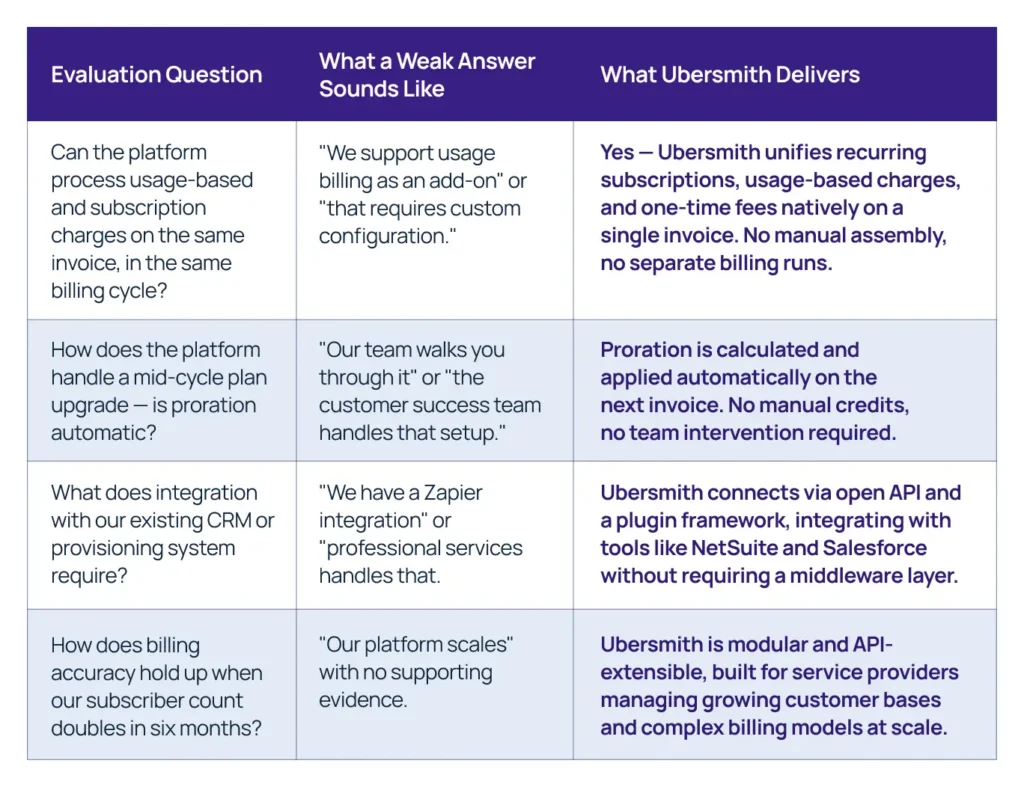
The right questions in a vendor evaluation will surface limitations that a demo rarely shows. These are the friction points that send growing SaaS teams back into the platform evaluation cycle eighteen months after their last switch. Getting clear answers before committing avoids that cycle entirely.
The Platform Decision Is a Growth Decision
Billing infrastructure is rarely treated as a strategic priority until it starts to limit what the business can do. A pricing model that worked cleanly at launch may create invoicing exceptions every cycle once usage-based tiers are introduced. A platform that handled a straightforward subscriber base may require manual work at scale that was never part of the original plan.
The SaaS companies that switch platforms are not necessarily the ones that chose the most sophisticated platform at the start. They are the ones who recognized when their current setup stopped scaling with them and made the switch before the workarounds became permanent fixtures in their billing process.
Ubersmith is built for service providers running subscription, usage-based, and hybrid billing models in a single environment. If your current platform is creating the friction points described in this guide, a conversation about your specific billing setup is the next right step.