
For cloud and dedicated server providers, the misalignment between support ticketing and billing platform extends to revenue and retention risk.
When a customer dispute generates a ticket in one system while the corresponding billing adjustment is queued in another, the operational cost is immediate. Finance operates without visibility into open issues, support acts without context on the account’s billing status, and resolution timelines stretch well past what the customer is willing to absorb. By the time ticketing and billing reach the same conclusion, it has already cost operational hours, customer trust, or revenue.
Choosing the right support ticketing and billing platform is one of the more consequential operational decisions a hosting or cloud operations manager can make. The eight criteria below provide you with a structured framework for evaluating your options and for quickly identifying which platforms were built to handle the operational complexity of your environment.
What To Look For In A Platform:
- 1. Native Unification of Ticketing and Billing
- 2. Automatic Ticket-to-Device and Service Linking
- 3. Usage-Based Billing Built Into the Platform
- 4. Automated Workflows Across Support and Billing Operations
- 5. Contract and Lifecycle Management Integrated Into the Same System
- 6. Infrastructure and Device Monitoring Connected to Billing Data
- 7. Open API Architecture and Integration
- 8. Unified Visibility Across Billing, Support, and Infrastructure
1. Native Unification of Ticketing and Billing
The distinction between native unification and middleware integration is among the most significant decisions in platform selection.
A platform that connects ticketing and billing through an API bridge is, structurally, still two systems with separate data models, independent sync cycles, and failure points. Middleware integration introduces sync delays, produces data discrepancies, and causes errors due to manual reconciliation. This chain of dependencies compounds at scale in ways that are difficult to reverse once embedded in daily operations.
A platform built on native architectural unification eliminates that chain entirely. Billing events trigger ticket creation, and ticket resolutions update billing records. In short, both functions draw from a single, consistent record.
While it is essential to ask a vendor whether their systems are connected, it is also important to evaluate whether their connectivity is structural or superficial.
2. Automatic Ticket-to-Device and Service Linking
When a support request comes in, the responding team should have immediate context — which device, which service, which contract, and the full billing history attached to that account. Without it, agents spend the opening of every interaction recovering information from different systems.
A capable support ticketing and billing platform links each ticket to the correct customer, device, or service without manual input. This results in fewer duplicate lookups, faster resolution, and consistent context from the first interaction.
This is particularly consequential in dedicated server environments, where a single account may carry multiple devices, overlapping service agreements, and a billing history that directly affects how an issue is diagnosed and resolved.
3. Usage-Based Billing Built Into the Platform
Cloud providers and dedicated server operators operate on revenue models tied to power consumption, bandwidth usage, data transfer, service activations, and plan changes — variables that shift materially month to month and cannot be managed accurately through flat-rate billing logic.
A platform without native usage-based billing capability routes that complexity directly into finance operations, where manual reconciliation becomes a monthly dependency. And that dependency is where revenue leakage (a missed overage, an uncollected bandwidth charge, or a miscalculated service tier) originates. Research even indicates that manual billing processes contribute to 3-5% revenue leakage in hosting and managed service environments.
The platform that fits this environment automates calculations and invoice generation from real-time usage data, with no manual reconciliation. In variable-revenue environments, it establishes the conditions under which accurate billing is even possible.
4. Automated Workflows Across Support and Billing Operations
Manual handoffs are where operational errors tend to occur. When a support resolution requires a billing adjustment that triggers a separate finance workflow, and that workflow requires access to a different system, each transition would only introduce delays, error risk, and the potential for a customer-facing dispute.
An effective support ticketing and billing platform automates workflows across both domains. Ticket routing and prioritization occur without manual assignment. Billing logic adapts automatically based on usage data, contract terms, and operational events.
For providers managing high-ticket volumes with lean teams, the ability to automate cross-functional workflows marks the difference between a team that scales and one that absorbs growth by adding headcount.
5. Contract and Lifecycle Management Integrated Into the System
Billing and support are operationally governed by contract terms. A service upgrade, a renewal, a downgrade, or a cancellation each carries downstream implications for both invoicing and case management. When those events are processed in a separate system, the gap between what was agreed and what is actually billed or visible to support widens.
Manual updates across disconnected platforms not only introduce lag; they also introduce version control risk. Billing runs on one version of a contract while support operates on another, creating inconsistencies and disputes that are difficult to resolve because no single record is authoritative.
The right integrated billing software connects contract lifecycle events directly to billing and support records in real time. Renewals apply automatically, pricing updates propagate without manual intervention, and service changes are visible across functions. This eliminates the administrative overhead that, for many providers, currently requires a dedicated process to manage.
6. Infrastructure and Device Monitoring Connected to Billing Data
This is the criterion that separates general-purpose help desk platforms from solutions designed for cloud and dedicated server environments. Device health determines what gets billed and when support is triggered, which are two functions that cannot be managed effectively from separate systems.
A platform makes operations proactive by monitoring power consumption, network health, bandwidth, and environmental conditions, and by connecting that data directly to customer accounts and service. When a performance threshold is crossed, the system automatically alerts the relevant team, generates a ticket, and surfaces the billing context attached to that device.
It also eliminates a persistent source of billing disputes. When usage data and device performance are stored on the same platform as billing records, discrepancies are identifiable before they reach the customer. In dedicated server environments, where hardware performance and customer invoicing are directly linked, this level of integration is highly needed.
7. Open API Architecture and Integration
Cloud or hosting providers do not operate identically. Billing workflows, service delivery processes, and support structures are built around specific environments and existing tool investments. A platform that requires those structures to be rebuilt around its own architecture will generate more adoption cost than operational value.
The right support ticketing and billing platform is extensible by design. An open API and plugin architecture allows integration with existing systems without requiring a wholesale operational overhaul. The platform conforms to the operation.
For cloud provider environments in particular, where infrastructure is complex and tool diversity is the norm, integration flexibility directly affects long-term platform viability and total cost of ownership. Providers that weight this criterion heavily during evaluation experience fewer post-launch failures and more predictable implementation outcomes.
8. Open API Architecture and Integration
If your operations team, your finance team, and your support team are working from different dashboards, they are working from different versions of the data. And decisions made from incomplete information carry operational risk.
A platform that surfaces revenue data, ticket status, usage metrics, device performance, and contract information in a single view gives all three functions the alignment they need to operate effectively. Escalations get shorter because context is shared. Revenue reporting becomes accurate because data is not split across systems. And leadership can identify problems before they affect retention because the full operational picture is visible in one place.
For hosting provider operations teams managing large and growing customer bases, unified visibility enables the business to scale without proportionally increasing headcount. A support ticketing and billing platform that delivers this level of cross-functional transparency removes the lag between managing operations and executive leadership.
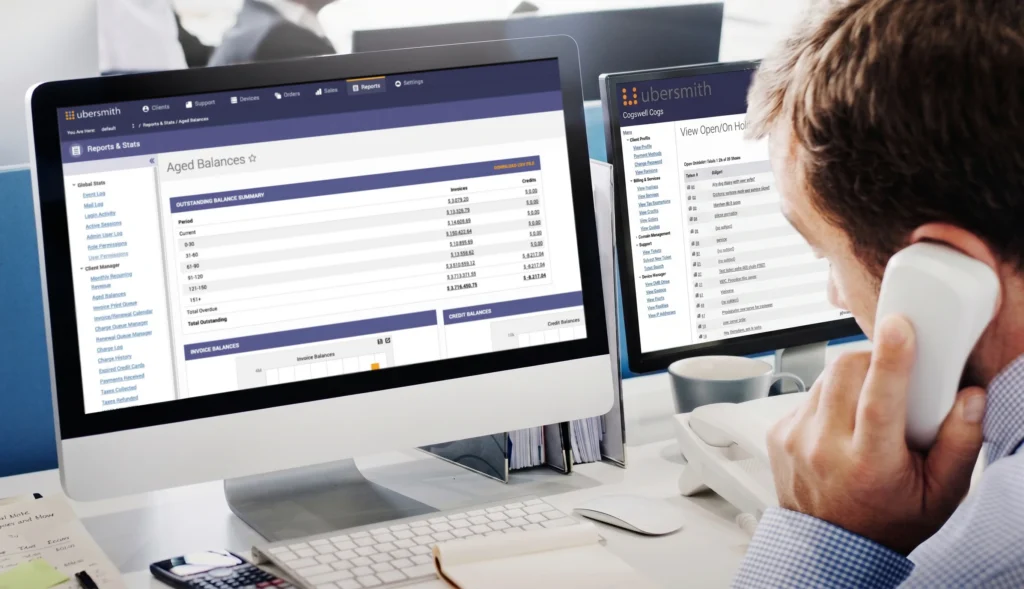
See How Ubersmith Brings All of This Together
Evaluating a support ticketing and billing platform against these eight criteria will quickly tell you which options were built for the operational complexity of cloud and dedicated server environments and which ones are not.
Providers that get this decision right reduce tool sprawl and close the operational gaps that cost time, revenue, and customer trust. Billing becomes accurate. Support becomes faster. And the teams responsible for both work from the same information.
Ubersmith is built for environments where all eight of these criteria matter. As an AI-automated billing and operations platform trusted by infrastructure providers, it brings support ticketing, usage-based billing, infrastructure monitoring, and contract management into a single unified system. With it, the gaps that cost your operation time, revenue, and customer trust stop being a recurring problem.
Learn more about the platform →
Frequently Asked Questions (FAQs)
1. Does Ubersmith support usage-based billing for power and bandwidth, or only subscription-based models?
Ubersmith handles both. It automates billing calculations for variable consumption — including power, bandwidth, and data transfer — alongside recurring subscriptions and one-time charges, all within the same platform.
2. If we already have existing tools for provisioning and network monitoring, do we have to replace them to use Ubersmith?
No. Ubersmith is built with an open API and plugin architecture, allowing it to integrate with your existing systems without requiring a wholesale operational overhaul. Your current tools stay in place, and Ubersmith connects to them.
3. How does Ubersmith link support tickets to billing records? Does this require manual configuration for each customer?
No manual configuration is required per customer. Ubersmith automatically links each ticket to the correct customer, device, or service upon creation, giving support teams immediate billing and service context without additional setup.