Is your billing currently in one system, your infrastructure monitoring in another, and your support tickets in a third tool? Are your contracts still tracked in a spreadsheet?
Running a data center, MSP, or hosting operation on three or four disconnected tools is a common starting point. For a while, the setup feels workable. It functions together until growth, a billing dispute, a missed contract renewal exposes exactly how fragile that arrangement is.
According to the Institute of Finance and Management, 39% of invoices contain errors. A separate study by Amalto Technologies also found that 61% of late invoice payments trace back to incorrect invoices, meaning delayed revenue is often a billing accuracy problem. PYMNTS.com reports that 45% of businesses struggle with manually reviewing invoices, pointing to a broader operational gap that automation directly addresses.
The question most operators reach at some point is not whether their current setup has problems. It is whether the cost of keeping it is lower than the cost of replacing it.
The Hidden Cost of a Patchwork Setup
The most visible cost of running disconnected tools is staff time. When usage data is stored in a monitoring system that does not feed directly into your billing platform, someone has to reconcile it manually every billing cycle. When contract renewals are tracked in a spreadsheet rather than automatically enforced, pricing updates are missed.
Poor contract management costs companies up to 9.2% of annual revenue (World Commerce & Contracting, 2025), and the average annual loss from missed renewals alone is $393,000 per organization (Sirion, 2026). For operators managing dozens of accounts with staggered billing cycles and scheduled uplifts, that number does not stay theoretical for long.
Beyond the revenue side, there is an operational drag that disconnected tools create at every layer of the business. Finance teams spend hours investigating billing discrepancies that stem from data sync failures between systems. Support staff work tickets with no visibility into the services or contracts attached to those accounts. Engineers manage device monitoring and billing in a completely separate system, requiring manual coordination to bridge the gap.
That overhead is considerably manageable at a certain size. But as the customer base grows, the manual coordination required to hold it all together grows with it. And at some point, the stack eventually becomes the bottleneck.
Where Disconnected Tools Drain Revenue
Three failure points appear consistently in hosting and infrastructure operations running on fragmented stacks.
1. Usage data that does not sync with billing.
When bandwidth consumption, power draw, or compute usage is tracked in a monitoring tool without a live connection to the billing system, invoices are built on stale or incomplete data. Clients get underbilled and the revenue that was earned is never collected.
2. Contract price increases tracked outside the billing system.
Renewals and scheduled price uplifts tracked in spreadsheets or separate CRM tools depend entirely on manual follow-through. When that step is missed — and in high-volume environments, it will be — the gap accumulates silently across every affected account until a review surfaces it.
3. Support tickets with no service context.
When a support ticket has no connection to the services, devices, or contracts on the account it references, resolution depends on manual investigation across disconnected systems. The result is slower response times, higher staff overhead, and a meaningful risk of resolving the wrong issue entirely. In client-facing operations, that kind of friction mostly shows in customer experience.
These failure points are not symptoms of poor management. They are the predictable outcome of any environment in which billing, monitoring, ticketing, and contract management operate as separate systems.
What Ubersmith Consolidates as a Hosting Automation Platform
Ubersmith is an AI-automated billing and operations platform built specifically for infrastructure providers operating on usage-based revenue models. That specificity matters because it determines what the platform actually automates versus what it still leaves to manual processes.
On the billing side, Ubersmith ties usage data directly to invoicing. Power, bandwidth, device metrics, and service consumption automatically feed into billing calculations, with no manual reconciliation between measurement and invoice. Contract lifecycle management also operates on the same principle. Price increases, renewals, and service updates are enforced through the platform rather than tracked externally, which means they execute on schedule regardless of team bandwidth.
Support ticketing connects directly to the services, devices, and contracts on each account. When a ticket is opened, the assigned agent has full service context, contract terms, and device history in a single view. This eliminates the cross-system investigation that drives resolution delays and support overhead in fragmented environments.
The operational outcome that Ubersmith creates is financially different.
• Reconciliation hours are recovered.
• Billing errors tied to data sync failures are eliminated.
• Contract uplifts execute on schedule.
• Revenue that was contractually earned but operationally missed gets captured.
For operators evaluating whether platform consolidation is worth the transition, these benefits often make the cost of staying on a fragmented stack indefensible.
Patchwork vs. Unified Platform: A Cost Comparison
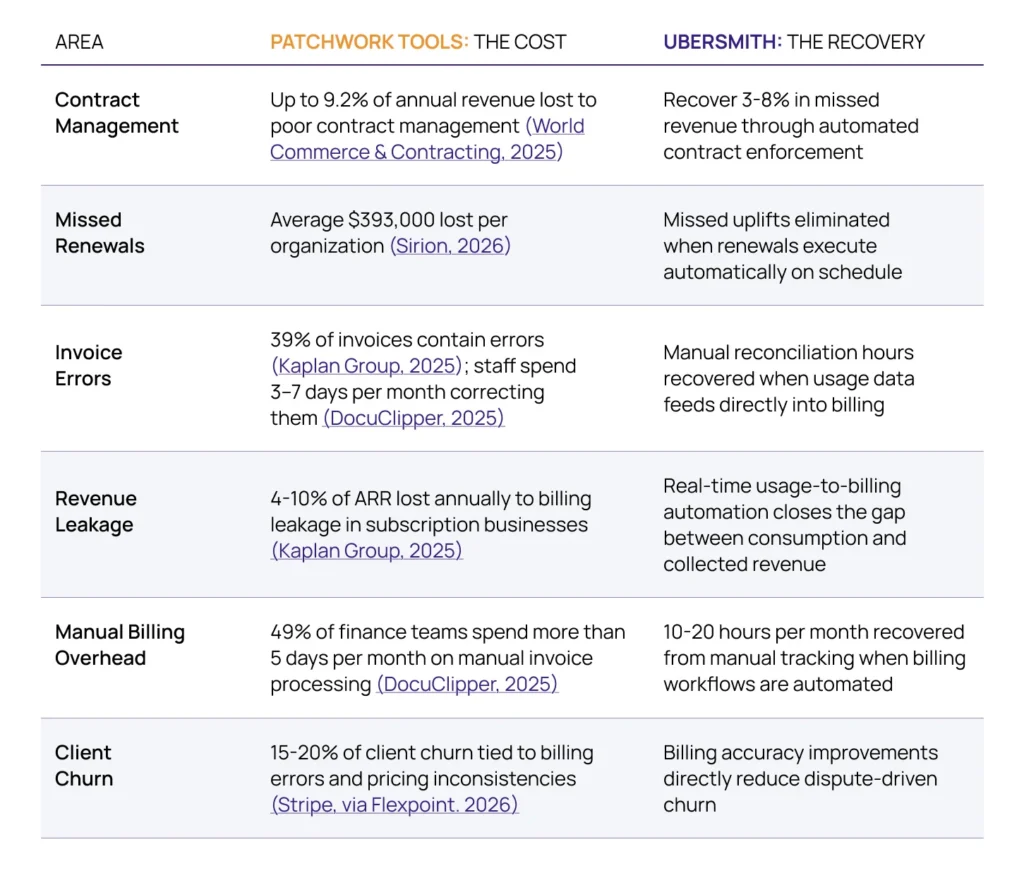
The figures in that table reflect documented industry losses. For organizations running on fragmented stacks, the cumulative financial exposure across contract management failures, billing inaccuracies, and manual overhead is measurable, recoverable, and directly tied to the infrastructure decisions being made now.
The Numbers Point One Way
The cost of running on disconnected tools rarely appears as a single line item. It accumulates across billing cycles, contract reviews, and support queues — quietly, and often without a clear owner. At the decision stage, the question is no longer whether the gaps exist, because the data already makes that clear. The question is whether the current setup is still the right one to carry forward.
Ubersmith was designed exactly for organizations that cannot afford the compounding cost of fragmented operations. The platform consolidates billing, contract lifecycle management, infrastructure monitoring, and support ticketing into a single system. It is purpose-built for the operational complexity these businesses actually face.
If the figures in this article reflect patterns recognizable in your own operation, a closer look at your current setup is a reasonable next step.
Learn more about how Ubersmith works or request a tailored walkthrough to see where automation closes the gaps.
Frequently Asked Questions (FAQs)
1. What is the difference between a hosting automation platform and patchwork tools?
A hosting automation platform integrates billing, infrastructure monitoring, contract management, and support ticketing into a single system. Patchwork tools handle each function independently, requiring manual coordination between them.
2. How much revenue can a hosting or data center operation lose from a fragmented billing setup?
Industry research points to losses of 3–5% of ARR from missed contract increases alone. For a company with $20M ARR, that translates to roughly $200,000 or more annually.
3. What does Ubersmith replace in a typical hosting operation’s tool stack?
For most operators, Ubersmith replaces standalone billing software, a network monitoring tool, a separate ticketing system, and spreadsheet-based contract tracking — consolidated into a single platform.
4. Is a hosting automation platform worth the switch if the current setup is functional?
Functional and cost-effective are different thresholds. A patchwork setup can process invoices and manage tickets while still incurring revenue losses from underbilling, missed uplifts, and reconciliation overhead. The relevant question is what the current tools are costing.
5. Which types of businesses benefit most from switching to a unified hosting automation platform?
Data centers, MSPs, ISPs, and hosting providers on usage-based or hybrid billing models see the most direct benefit. These environments are where the volume and complexity of usage data make manual coordination between disconnected tools most costly.