Key Takeaways:
• Contract Lifecycle Management (CLM) software manages the full operational span of a customer relationship, from onboarding and provisioning through billing, contract renewals, and offboarding.
• Core functions of CLM software include contract management, usage-based billing, provisioning, service modifications, renewal tracking, and support visibility.
• CRM software handles sales pipelines and communications. CLM manages the operational and financial workflows that follow the sale.
• Organizations managing financial workflows usually face measurable operational and revenue risks like missed renewals, underbilling, inaccurate invoices, and increased customer churn.
Managing a customer relationship in an infrastructure or services business extends beyond handling more than account communications and renewals. Contracts carry specific pricing terms and expiration dates. Services need to be provisioned accurately. Usage data has to translate into billing without consistency issues. And support teams need visibility into a customer’s full service history to resolve concerns without sending people in circles.
According to Juro, only 11% of businesses rate their contract management as very effective. The rest deal with unclear ownership, fragmented storage, and manual workflows that create pricing errors over time. Most teams manage these workflows across several disconnected systems, where one tool handles billing, another tracks contracts, and provisioning happens on a separate tool. When these systems do not share data in real time, gaps appear. And when gaps appear, it costs revenue.
Contract Lifecycle Management (CLM) software is built to exactly address this kind of fragmentation. This article explains what it is, what it covers, and why it matters.
What Is Contract Lifecycle Management Software?
Contract Lifecycle Management (CLM) software manages the full operational span of a customer relationship. It begins at onboarding and covers every operational event that follows, including service provisioning, contract management, billing, service changes, renewals, and eventual offboarding.
The term “lifecycle” in this context refers to operational and revenue stages, not the marketing or sales funnel stages commonly defined.
Customer Relationship Management (CRM) platforms manage the pipeline to the sale: leads, opportunities, communications, and handoffs.
Contract Lifecycle Management (CLM) software, on the other hand, manages what comes after. This includes the signed contract, the provisioned services, the monthly billing, and the renewal upon expiration of the term. Moreover, CLM software creates a unified operational record for each customer. Services, pricing schedules, contract terms, and billing history can all be found in one place and updated as circumstances change.
What Contract Lifecycle Management Software Covers
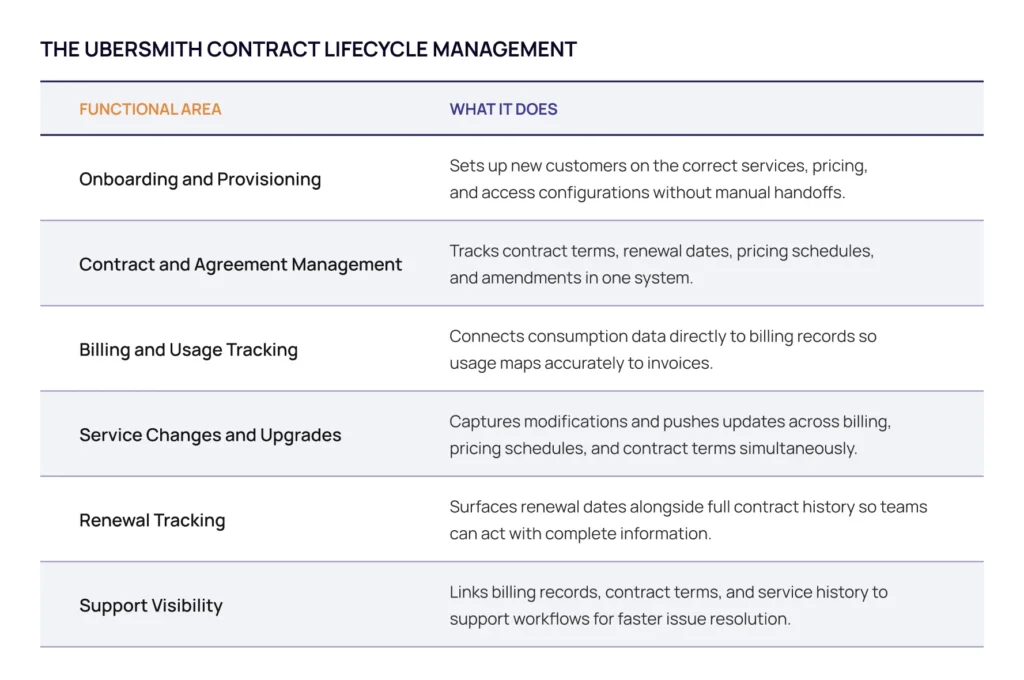
As mentioned above, CLM software typically addresses six functional areas across the customer relationship:
1. Onboarding and provisioning
New customers need to be set up on the right services with correct pricing and access configurations. CLM software structures this process so provisioning moves consistently, without relying on manual handoffs between teams.
2. Contract and agreement management
Contract terms, renewal dates, pricing schedules, and amendments are tracked in one system. Every change made during the contract term, whether a pricing update or a service modification, is recorded against the original agreement so nothing falls out of sync.
3. Billing and usage tracking
Usage-based services require billing that reflects actual consumption. CLM software connects usage data directly to billing records, reducing the discrepancies that lead to invoicing disputes, delayed payments, and unrecovered revenue.
4. Service changes and upgrades
When a customer modifies their service, billing and contract records need to update accordingly. CLM software captures service changes and triggers automatic updates simultaneously, so every record reflects the customer’s current service state at any given point.
5. Renewal Tracking
Automated renewal visibility replaces spreadsheet-based reminders. Teams approach renewals with full context on pricing history and contract terms, giving teams enough lead time to prepare and making renewal conversations more accurate.
6. Support Visibility
When a support ticket comes in, CLM software surfaces the customer’s billing records, contract terms, and service history in the same view. Teams spend less time reconstructing the full context for each ticket and more time resolving the actual issue.
How It Works in Practice
The foundation of Contract Lifecycle Management (CLM) software is a connected customer record. Every service, every contract term, and every billing event for a given customer is stored in one system and updated in real time as circumstances change.
When a service is added or modified, the system registers the change and applies it across billing, the contract record, and the customer’s service profile simultaneously. When a renewal date approaches, the system surfaces it alongside the full contract history so the team can act on it with complete information. When a support ticket comes in, the relevant billing and service data is already attached.
With CLM software, every team touching a customer relationship, whether in finance, operations, or support, is working from the same record. The data compilation published by Procurement Tactics, citing Zoho’s 2026 CLM report, found that 47% of CLM users saved 7 to 10 hours per week after implementation. 26% of the respondents also reported a 40% to 50% reduction in workload after using CLM tools. These results further reflect the operational efficiency that teams gain when billing, contracts, and service data are no longer in silos.
Why It Matters for Infrastructure and Service Operators
The downstream consequences of managing customer lifecycle workflows manually are measurable.
According to an MGI Research survey, as cited in LeakShield Technologies’ guide, usage-based billing models lose between 4 and 9% of revenue to leakage. Per the Churn Report for the B2B market, up to 40% of total churn is involuntary, driven by billing failures and unresolved payment processing issues. At the contract level, Juro’s research found that 40% of a contract’s value can be lost as a result of inefficient contract management processes. From these data, it can then be concluded that when billing, churn, and contract performance are managed manually across disconnected systems, revenue gaps follow.
For infrastructure operators, where provisioning accuracy sets the operational tone for the entire customer relationship, the onboarding process carries significant weight in determining customer retention. Meanwhile, for businesses running usage-based revenue models, the stakes are especially high. Billing accuracy depends on consumption data flowing correctly from the service layer into the invoicing system. A single data mismatch creates a billing dispute. And at scale, recurring mismatches create a significant revenue loss.
See It In Practice
Understanding what Contract Lifecycle Management software does helps clarify where manual processes introduce risk. The more complex the service model, the more likely that risk is already showing up somewhere. It can surface in billing disputes, missed renewals, provisioning delays, or customer churn that traces back to operational misalignment.
Ubersmith’s platform is built for infrastructure operators managing exactly this kind of complexity.
Visit Ubersmith to learn more about the platform, or request a demo to see how it handles billing, contracts, provisioning, and renewals in practice.
Frequently Asked Questions (FAQs)
1. What is the difference between CLM software and CRM software?
CRM manages the pipeline to the sale: leads, opportunities, and communications. CLM manages what happens after: contracts, provisioning, billing, renewals, and service changes. They serve different stages of the customer relationship and are not interchangeable.
2. Does CLM software handle usage-based billing directly?
Yes. CLM software connects usage data to billing records so that what gets consumed maps directly to what gets invoiced. This is particularly relevant for infrastructure operators billing for bandwidth, power, or compute resources where consumption varies per customer per cycle.
3. What operational problem does CLM software solve that standard billing tools do not?
Standard billing tools process invoices. CLM software connects billing to the full customer record (contracts, service history, provisioning status, and renewal timelines) so changes in one area update the others automatically.
4. At what point does managing customer lifecycle workflows manually become a problem?
It typically surfaces when service modifications stop reflecting accurately in billing, when renewal dates get missed, or when support teams cannot access a customer’s full service history without pulling from multiple systems.
5. Can CLM software be implemented incrementally, or does it require a full operational overhaul?
It can be adopted gradually. Contracts and lifecycle tracking can be applied to new customers first while existing service workflows continue as before, allowing teams to transition without disrupting current operations.