Key Takeaways:
• Most AI-powered infrastructure management platforms are primarily built for operational visibility, not revenue accuracy.
• The disconnect between monitoring and invoicing is a structural problem, and usage exposure accumulates undetected because of it.
• Manual reconciliation is where revenue gets lost, and it rarely surfaces until an audit or a client dispute.
• Closing the gap between infrastructure data and invoicing requires both functions to operate within a unified platform.
AI-powered infrastructure management discussions tend to focus on the layer that is immediately visible. They mostly cover monitoring dashboards, automated alerts, and real-time capacity data. For service providers, these capabilities have become foundational to daily operations. Devices are tracked, thresholds are enforced, and provisioning has grown considerably less reliant on manual intervention.
There is a problem, though, that consistently surfaces downstream from these functions. It does not appear on infrastructure dashboards and is typically identified during billing reconciliation. Usage is carefully tracked and assets are properly accounted for, but revenue continues to erode. This gap does not trace back to the monitoring layer, but to what actually follows after it.
What AI-Powered Infrastructure Management is Built To Do
AI-powered infrastructure management platforms were designed around visibility and operational control. Their primary function is to deliver continuous, real-time intelligence across the environment:
• Device Health
• Network Performance
• Capacity Utilization
• Power Consumption
• Bandwidth Traffic
When performance begins to degrade or anomalies emerge, the platform surfaces them. And when provisioning events occur, modern platforms resolve them without manual intervention.
These capabilities have matured considerably. Current platforms ingest signals across thousands of devices simultaneously, apply machine learning to anomaly detection and pattern recognition, and measurably reduce the operational burden on infrastructure teams. For IT directors and directors of infrastructure, that level of visibility fundamentally changes how environments are governed. Organizations managing high volumes of concurrent customer environments gain meaningful control over operational overhead — a capacity that would otherwise require proportional headcount. From these merits alone, it can be deduced that the investment in AI infrastructure tooling is well justified.
Why the Billing Layer Ends Up Disconnected
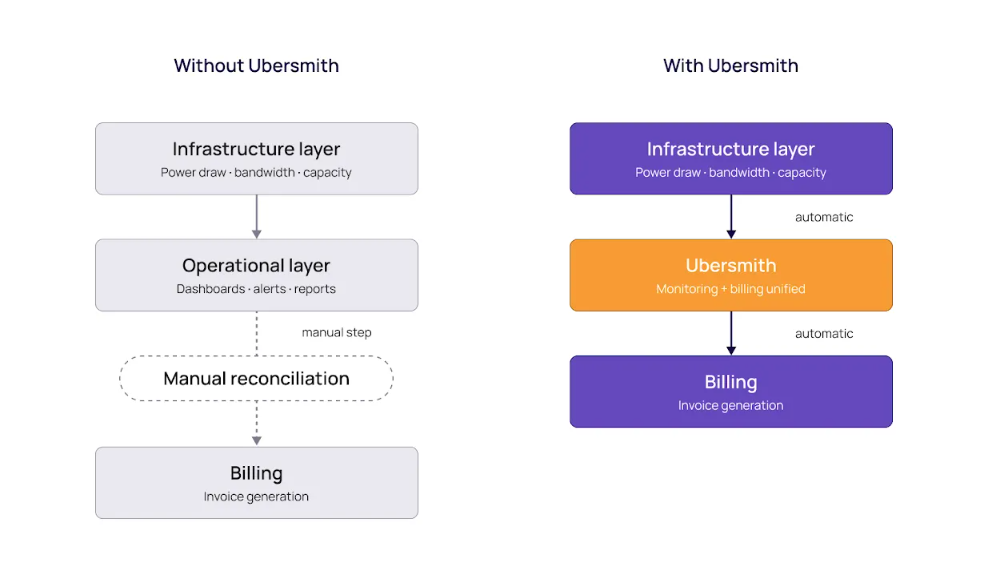
As mentioned above, the gap is not in what these platforms monitor. It sits in what happens after monitoring. Usage data, including power draw, bandwidth consumption, and device allocation, is captured at the infrastructure layer with increasing accuracy. That data flows into operational dashboards, alert queues, and capacity reports. Getting it into a billable invoice is an entirely different route, and in most provider environments, that route remains manual.
If a usage report is extracted, it moves through a reconciliation process. Some portions are matched to customer contracts, and some are not. The longer the billing cycle is, the more difficult it becomes to account for what went unrecorded. At scale, this is where revenue is lost.
The reason this persists is because of structural absence. Most AI infrastructure management platforms were built by teams whose main mandate was operational reliability for early buyers like IT and infrastructure leaders. Vendors responded accordingly, initially optimizing for faster incident response, better capacity planning, and reduced unplanned downtime. Responsibility for financial accuracy was deferred entirely to other systems.
As these platforms matured, the monitoring and automation capabilities deepened considerably. However, the billing layer stayed largely where it was — separate, dependent on manual effort, and reliant on manual intervention.
For service providers operating on usage-based models, the exposure that accumulates from this disconnect often goes undetected until a reconciliation effort or a client dispute forces it into view.
What Connecting the Two Layers Actually Requires
Layering additional integrations across disconnected systems does not resolve the underlying problem. It multiplies failure points, and the reconciliation burden does not disappear; it only shifts to a different stage in the same cycle. The resolution requires infrastructure data and billing logic to operate within a unified environment, where usage flows into invoices automatically and without a manual hand-off at the close of every billing period. That architectural distinction separates platforms purpose-built for infrastructure service providers from conventional billing tools with monitoring capabilities appended after the fact.
Ubersmith, an AI-automated billing platform, was designed around this architecture. Device monitoring, usage tracking, contract management, and billing operate within a single platform. Power consumption, bandwidth usage, and service changes are captured at the infrastructure layer and applied directly to billing without a discrete reconciliation step.
For providers operating on usage-based or hybrid revenue models, Ubersmith provides the difference between invoicing for what was delivered and invoicing for what a team could piece together at month-end.
The Operational Case for Closing the Distance
If your infrastructure is generating usage data that is not making it into billing accurately, the gap described here is likely contributing to revenue you are not recovering.
Ubersmith offers a tailored walkthrough of how the platform connects infrastructure monitoring and billing accuracy in a single operational environment.
See how it maps to your current setup here.
Frequently Asked Questions (FAQs)
1. Does AI-powered infrastructure management prevent billing errors?
Not on its own. These platforms are built to monitor performance and automate provisioning — not to translate usage data into invoices. That translation step usually still runs through a separate, manual process, which is where billing errors and missed charges creep in.
2. Why does revenue leakage go unnoticed for so long?
Because everything downstream still looks normal. Invoices go out, customers pay, and reports are balanced. The leakage shows up in what was never billed in the first place, not in an error anyone can flag. It’s usually only caught during a reconciliation audit or a customer dispute.
3. What’s the difference between infrastructure monitoring and infrastructure billing?
Monitoring tracks usage, performance, and capacity in real time. Billing turns that usage into a customer-facing invoice. They’re often built as separate systems with a manual handoff between them, which is the seam where revenue gets lost.
4. How do providers stop billing leakage without adding more tools?
The fix isn’t another integration because it only adds failure points rather than removing them. The more durable fix is running monitoring and billing in one platform, so usage flows directly into invoices without a manual reconciliation step at period close.