
Somewhere between the third spreadsheet update of the month and a billing dispute that should have been closed automatically, the cost of the wrong infrastructure software becomes impossible to ignore.
U.S. hosting providers, such as colocation facilities, ISPs, and bare-metal operators, are operating at a scale where manual processes introduce measurable financial risk. Operators lose an estimated 1–3% of annual revenue to leakage, a figure that compounds as subscriber volume and service complexity increase.
For organizations managing hundreds of customer contracts, metered usage across power and bandwidth, and provisioning workflows that must translate directly into accurate invoices, the margin for operational error is narrow. The providers actively evaluating AI-automated hosting infrastructure software are well aware that a recoverable loss is embedded in their current setup, and another billing cycle without addressing it will extend that loss further.
Most Hosting Infrastructure Software Wasn’t Built to Protect Revenue
When evaluating AI-automated hosting infrastructure software, the most consequential question is not which platform offers the most features; it is whether the platform is designed to support the billing model that hosting operations actually use. Generic billing platforms manage subscription logic competently. They were built for flat-rate plans, seat-based pricing, and SaaS renewal cycles, and they perform well within those parameters.
Hosting infrastructure operates under different conditions. Power consumption, bandwidth usage, device counts, and service tiers fluctuate continuously — sometimes within a single billing period. A platform engineered for subscription models cannot reconcile metered usage data against tiered pricing schedules and produce an accurate invoice without manual intervention. That gap between what is consumed and what is billed is where revenue erodes quietly across every cycle.
Ubersmith was purpose-built for infrastructure providers where billing is a direct function of physical and network resource consumption. The platform connects usage data, contract terms, infrastructure activity, and support workflows within a single operational environment. The data that drives billing is the same data generated by operations, eliminating the reconciliation layer where most leakage occurs.
Three Places U.S. Hosting Providers Lose Revenue
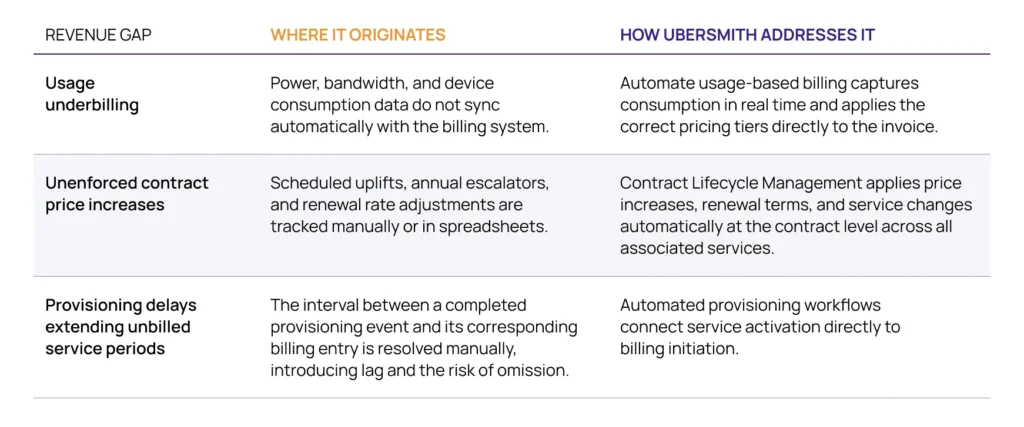
Revenue leakage in hosting operations rarely originates from a single systemic failure. It accumulates across three distinct points. Each is manageable in isolation, but compounding in impact when all three run on manual or disconnected systems.
1. Usage underbilling.
Underbilling is the most prevalent source of leakage exposure. When usage data from network devices, power meters, or server infrastructure does not sync automatically with the billing system, charges are estimated, missed, or applied inconsistently across billing cycles. For a provider carrying $20M in annual recurring revenue, a 1% underbilling rate from usage tracking gaps alone can represent approximately $200,000 in unrecovered revenue annually.
2. Unenforced contract price increases.
Scheduled uplifts, annual escalators, and renewal rate adjustments are among the most reliable revenue recovery levers available to hosting operators. However, their value is contingent on consistent execution. When increases are tracked manually or managed across spreadsheets at scale, they are missed. According to a 2022 BCG report, unexecuted contract price adjustments can cost organizations 3.5% of potential revenue — a gap that exceeds $1M on a $30M revenue base when increases are not consistently enforced.
3. Provisioning delays that extend unbilled service periods.
In hosting environments, the interval between a completed provisioning event and its corresponding billing entry can represent a delivered service that has not been captured as revenue. When provisioning and billing operate as disconnected workflows, the interval is closed through manual reconciliation, introducing both lag and the risk of omissions. At scale, across concurrent activations, service modifications, and contract changes, the cumulative exposure from unbilled service periods compounds materially across each billing cycle.
What AI Automation Actually Changes at the Infrastructure Level
Each of the three revenue gaps identified above has a direct resolution within a purpose-built platform such as Ubersmith. The distinction between generic infrastructure software and AI-automated hosting infrastructure software is most visible in how the system manages data flow between operations and billing.
1. Usage underbilling – Ubersmith’s automated usage-based billing captures power, bandwidth, and device consumption in real time and applies the correct pricing tiers directly to the customer’s invoice. The usage event recorded at the infrastructure level becomes the charge recorded in billing, with no manual sync step in between.
2. Contract enforcement – Ubersmith’s Contract Lifecycle Management module applies scheduled price increases, renewal terms, and service changes automatically at the contract level, across all associated services simultaneously. An uplift configured once executes consistently across every renewal cycle without manual intervention.
3. Provisioning-to-billing lag – Ubersmith’s automated provisioning workflows connect service activation directly to billing initiation. When a service is provisioned, billing automatically starts. The lag is eliminated structurally, not managed around.
Many providers around the world have already operated on this unified platform, where infrastructure data, contract terms, and billing logic run within a single system rather than across separate tools that require constant reconciliation.
Why U.S. Hosting Providers Are Moving on This Now
U.S. hosting providers are now adding subscribers, launching new service tiers, and fielding more complex contracts than their current systems were designed to handle. Every layer of growth — more customers, more services, more usage data — adds reconciliation work to a team already managing at capacity.
The providers who wait are incurring recoverable losses with each additional billing cycle, while their operations teams absorb the manual overhead of a system that scales headcount. The shift to AI-automated hosting infrastructure software is a revenue decision before it’s a technology one.
Identify where revenue is leaving your operation. Visit Ubersmith today or contact our team to see the platform against your own infrastructure environment.
Frequently Asked Questions (FAQs)
1. What makes AI-automated hosting infrastructure software different from standard billing platforms?
Standard billing platforms are built for subscription and seat-based pricing models. AI-automated hosting infrastructure software is designed to handle metered usage (power, bandwidth, device counts) and connect that usage data directly to billing without manual reconciliation.
2. Is Ubersmith suitable for smaller U.S. hosting providers or only enterprise-scale operations?
Ubersmith serves providers across a range of operational sizes, including mid-market hosting operators, ISPs, and colocation facilities. The platform is modular, so providers can implement the capabilities most relevant to their current operation and expand from there.
3. How long does it typically take to implement AI-automated hosting infrastructure software?
Implementation timelines vary based on the complexity of existing systems and data migration requirements. Ubersmith provides hands-on onboarding support and has a 60–90-day average sales-to-close cycle, which reflects the scoping and implementation planning that happens before deployment begins.
4. What should hosting providers look for when evaluating infrastructure software options?
The most important evaluation criteria are: (1) whether the platform supports metered usage billing natively, (2) how contract enforcement and renewal automation are handled, (3) whether infrastructure monitoring data feeds directly into billing, and (4) whether the system consolidates billing, ticketing, and device management into one environment.